Premises Licence Variation or New Application?

Changing a licensed premises in England and Wales can look straightforward at first glance. If there is already a premises licence in place, the natural instinct is often to submit a premises licence variation and build on what exists. In practice, that is not always the safest route, because a variation can reopen scrutiny of the licence, attract representations, and lead to conditions that affect the whole operation.
For operators, landlords, buyers, and advisers, the key question is not simply “Can this be varied?” It is “Which application route gives the business the best chance of achieving its commercial aim while managing licensing risk?” That judgement needs a clear understanding of the existing permission, the proposed changes, the local area, and the likely response from responsible authorities and residents.
Why the obvious route is not always the safest
A full variation premises licence application can be useful when an operator wants to change licensable activities, extend hours, alter plans, amend the operating schedule premises licence proposals, or remove or amend premises licence conditions. It keeps the existing licence alive and asks the licensing authority to approve specific changes. On paper, that can feel efficient.
The risk is that a full variation is not assessed in a vacuum. Once advertised and consulted upon, it can invite responsible authorities and other persons to look again at how the premises operates. If relevant representations are made, the application may go to a licensing sub-committee. At that point, the authority can grant the variation, reject it, or add or modify conditions in response to the licensing objectives.
That does not mean a premises licence variation should be avoided. It means the route should be chosen deliberately. Sometimes a new premises licence application may provide a cleaner framework, particularly where the existing licence has awkward historic conditions, outdated plans, unclear permissions, or a record of problems that may cloud the discussion.
What is a premises licence?
A premises licence is the permission, granted under the Licensing Act 2003 framework in England and Wales, that authorises licensable activities at a specific premises. These activities commonly include the sale of alcohol, late night refreshment, regulated entertainment, or a combination of them. An alcohol premises licence will also require a designated premises supervisor where alcohol is sold by retail.
The licence is more than a certificate. It includes plans, permitted activities, licensed hours, mandatory conditions, and any extra premises licence conditions imposed or agreed to promote the licensing objectives. Those objectives are the prevention of crime and disorder, public safety, prevention of public nuisance, and protection of children from harm.
When someone wants to apply for premises licence approval, the operating schedule is central. This sets out what the applicant proposes to do, when activities will take place, how the premises will be managed, and what steps will be taken to promote the licensing objectives. Whether you are considering a premises licence application for the first time or reviewing an established venue, the detail of the operating schedule often shapes the authority’s confidence in the proposal.
The main routes for changing or securing a licence
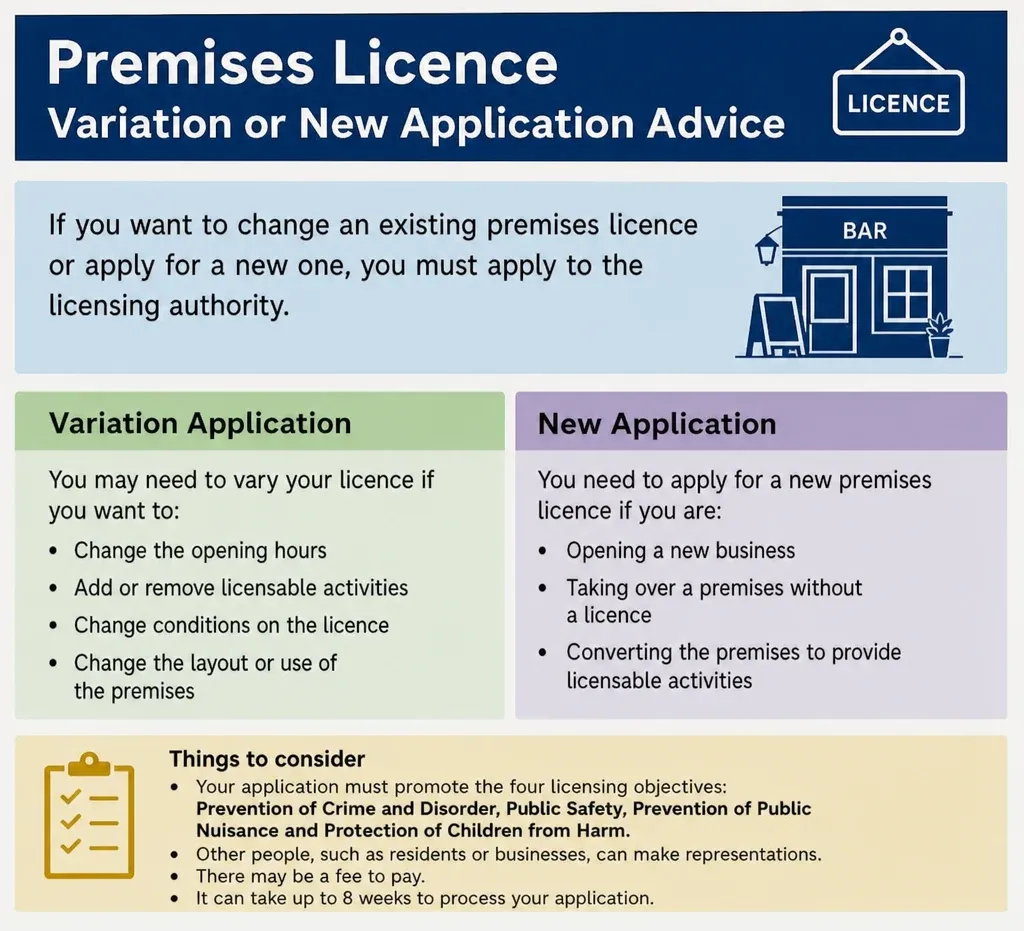
There is rarely a one-size-fits-all answer in premises licensing. The right route depends on the scale of change, the existing licence, and the likely impact on the local community. In broad terms, the options usually fall into three categories.
- Minor variation premises licence application: This is intended for small changes that cannot adversely impact the licensing objectives. It may be suitable for modest plan changes, limited condition amendments, or other low-risk adjustments. It is not designed for substantial increases in hours or activities.
- Full variation premises licence application: This is used for more significant changes to an existing licence, such as adding licensable activities, extending hours, materially changing the layout, or altering important conditions. It involves wider consultation and formal advertisement.
- New premises licence application: This asks the licensing authority to grant a fresh licence. It may be preferable where the operator wants a different licensing structure, where the existing licence is unsuitable, or where varying it would bring unnecessary complications.
The distinction matters because each route carries different procedural requirements, consultation risks, and possible outcomes. A minor variation may be quicker, but only if the proposed change is genuinely minor. A full variation may appear commercially neat, but it can expose the current licence to debate. A new application may take more preparation, but it can allow the applicant to present a coherent modern operating model from the start.
When a variation may be the right option
A premises licence variation often works well where the existing licence is broadly sound and the proposed change is limited, logical, and easy to explain. For example, an operator may need to update a plan after refurbishment, adjust the wording of a condition that no longer fits the layout, or add a modest activity that aligns with the venue’s current style.
The strongest variation applications are usually supported by a clear narrative. The licensing authority should be able to understand what is changing, why it is needed, and how the licensing objectives will continue to be promoted. If the proposal is sensible, proportionate, and consistent with the premises’ history, a variation may be the most practical route.
Before choosing this path, it is worth reviewing:
- whether the existing licence is accurate and complete;
- whether the current plans still match the premises;
- whether any existing conditions are outdated, duplicated, unclear, or too restrictive;
- whether the proposed change could concern police, environmental health, trading standards, safeguarding, or local residents;
- whether the premises sits in a cumulative impact area or another sensitive location;
- whether the application could be narrowed to reduce risk.
This early review helps avoid treating a variation as an administrative exercise when it is, in reality, a public licensing application.
When a new premises licence application may be safer
A new premises licence application can be the more strategic choice where the existing permission carries baggage. That baggage may be legal, practical, or presentational. An old licence may contain conditions drafted for a previous business model, plans that no longer reflect the trading layout, or hours and activities that do not fit the intended use.
A fresh application allows the applicant to put forward a complete operating schedule premises licence proposal that reflects the business as it will actually trade. It can also avoid the awkwardness of trying to amend several parts of a licence that no longer work together. Instead of patching an unsuitable permission, the operator asks for a clean, coherent licence.
This approach may be worth considering where:
- the existing licence has numerous historic conditions that are difficult to interpret;
- the proposed concept is materially different from the old use;
- the premises has changed layout or operation substantially;
- the licence history may distract from the merits of the new operator’s proposal;
- the desired permissions are better expressed through a fresh operating schedule;
- varying the existing licence could invite arguments about the whole premises rather than the proposed change.
A new application is not automatically lower risk. It may still receive representations and may still require a hearing. However, it can give the applicant more control over how the proposal is framed.
Why conditions deserve close attention
Premises licence conditions are often where the practical consequences of an application are felt most strongly. A condition may look harmless during negotiation but become difficult once the venue is trading. Conditions can affect staffing, door supervision, CCTV, dispersal, deliveries, waste handling, outdoor areas, noise controls, training, age verification, and incident recording.
When applying to vary a licence, operators sometimes focus on the headline request, such as later hours or an amended layout. Yet responsible authorities may respond by asking for new conditions or tighter wording. If accepted too quickly, those conditions can limit flexibility, increase operating costs, or create compliance risks.
Good conditions should be clear, enforceable, proportionate, and linked to the licensing objectives. They should also match the premises. A small café, a city-centre bar, a restaurant, a hotel, and a late-night venue will not usually need the same style of control. Practical drafting matters because the licence must work not only on the day it is granted, but throughout the life of the business.
The role of the operating schedule
The operating schedule is the applicant’s opportunity to show how the premises will be run responsibly. It should not be treated as a formality or filled with vague promises. In both a full variation premises licence application and a new premises licence application, the operating schedule can influence whether responsible authorities feel reassured or concerned.
A strong schedule usually explains the proposal in plain terms. It identifies the licensable activities, hours, layout, customer profile, management controls, and steps to promote the four licensing objectives. It should be realistic. Overpromising can create conditions the operator later struggles to meet, while under-explaining can leave avoidable gaps that invite objections.
Useful points to consider include:
- Crime and disorder: How will staff manage incidents, refusals, drugs risks, disorder, and communication with police where appropriate?
- Public safety: Are capacity, evacuation, staff training, and customer movement properly considered?
- Public nuisance: How will noise, dispersal, smoking areas, deliveries, waste, and outdoor use be controlled?
- Protection of children: Are age verification, staff training, safeguarding risks, and family-friendly arrangements addressed where relevant?
The best schedules are neither defensive nor exaggerated. They show that the operator understands the premises and has thought about foreseeable issues.
How should you choose between variation and new application?
You should choose between a premises licence variation and a new application by comparing the legal process, the commercial objective, the condition risk, and the likely reaction to the proposal. The safest route is not always the fastest or the most familiar. It is the route that gives the proposal the clearest path while protecting the long-term usability of the licence.
A practical decision process might look like this:
- Start with the end goal. Define exactly what permission the business needs, rather than beginning with the form you expect to submit.
- Audit the existing licence. Check plans, activities, hours, conditions, and any obvious inconsistencies.
- Assess local sensitivity. Consider nearby residents, schools, transport hubs, crime concerns, nuisance history, and local licensing policy.
- Identify consultation risks. Think about which responsible authorities may engage and what they are likely to ask.
- Compare outcomes. Ask whether a variation would leave the licence messy, restrictive, or vulnerable to extra conditions.
- Plan the evidence. Prepare a clear operating schedule, supporting explanation, and proportionate conditions where appropriate.
This approach helps shift the conversation from “Which application is easiest?” to “Which application is most robust?” That is usually the better question for operators who want a licence they can actually trade under.
Common traps for operators and buyers
Premises licensing decisions often become riskier when they are left until late in a transaction, refurbishment, or launch plan. A buyer may assume an existing premises licence is suitable because the premises has traded before. A tenant may sign a lease before checking whether the licence supports the intended hours, layout, or alcohol offer.
Several issues come up repeatedly:
- assuming a licence can simply be “transferred” when the real issue is whether it permits the proposed operation;
- overlooking conditions that restrict music, outdoor seating, deliveries, or late-night trading;
- treating a minor variation premises licence route as available when the change may be too significant;
- submitting a full variation without considering whether it may attract broader scrutiny;
- failing to align planning, lease terms, and premises licensing requirements;
- using generic condition wording that does not fit the venue.
None of these points means the project cannot proceed. They do mean the licensing strategy should be checked early, ideally before money is committed to designs, works, contracts, or launch dates.
A careful route protects the business
Premises licensing is not just about getting an approval. It is about securing permission that supports the business model, satisfies the licensing objectives, and remains workable in day-to-day operation. Whether you apply for premises licence approval from scratch or seek a premises licence variation, the quality of the preparation matters.
The safest route may be a minor variation, a full variation, or a new premises licence application. The answer depends on the facts, the existing licence, the proposed operation, and the local licensing environment. A licensing consultancy can add value by testing those factors before the application is made, helping the applicant avoid avoidable objections, unclear conditions, or a licence that looks good on paper but causes problems in practice.
If you are weighing up a variation against a new premises licence application, pause before choosing the obvious route. Review the licence, define the commercial objective, and consider how the proposal will be seen by the licensing authority and responsible authorities. A measured decision at the start can save time, cost, and frustration later, while giving the business a stronger platform to trade responsibly.
Questions and answers
Should I vary an existing premises licence or apply for a new one?
It depends on the existing licence, the scale of the change, and the local picture. A variation often suits a licence that is broadly sound where the change is limited and easy to explain. A new application can be the stronger choice where the existing permission carries baggage — historic conditions, outdated plans, or a use that no longer matches the business.
Can applying to vary a licence put the existing licence at risk?
It can widen the discussion. Once a full variation is advertised and consulted upon, responsible authorities and other persons may look again at how the premises operates. If relevant representations are made, the application can go to a licensing sub-committee, which may grant it, reject it, or add or modify conditions.
When is a minor variation the right route?
A minor variation is intended for small changes that cannot adversely impact the licensing objectives — modest plan changes, limited condition amendments, and other low-risk adjustments. It is not designed for substantial increases in hours or activities, and treating a significant change as minor is a common trap.
Why do premises licence conditions deserve so much attention?
Conditions are where the practical consequences are felt. They can affect staffing, door supervision, CCTV, dispersal, deliveries, waste, outdoor areas, noise, training, age verification, and incident recording. A condition accepted quickly during negotiation can limit flexibility or add cost for the life of the licence, so wording matters.
What should the operating schedule cover?
It should explain the proposal in plain terms: the licensable activities, hours, layout, customer profile, management controls, and the steps that will promote the four licensing objectives. It should be realistic — overpromising creates conditions that are hard to meet, while under-explaining leaves gaps that invite objections.