The aftermath of a licensing incident: Turning lessons into better staff training

When an incident occurs at a licensed premises, there can be a lot of work involved in supporting customers and staff, providing information to the police and providing the team with instructions on what to do next.
Once the immediate incident is under control and the report has been completed, it can be tempting to file the paperwork away and continue with business as usual. However, taking the time to understand what happened and how it was dealt with can reveal opportunities to improve the way your premises operates. It could be treated in the same way as a health and safety incident; conducting an internal investigation of what went well or not so well, to identify areas of improvement to prevent a similar incident occurring again.
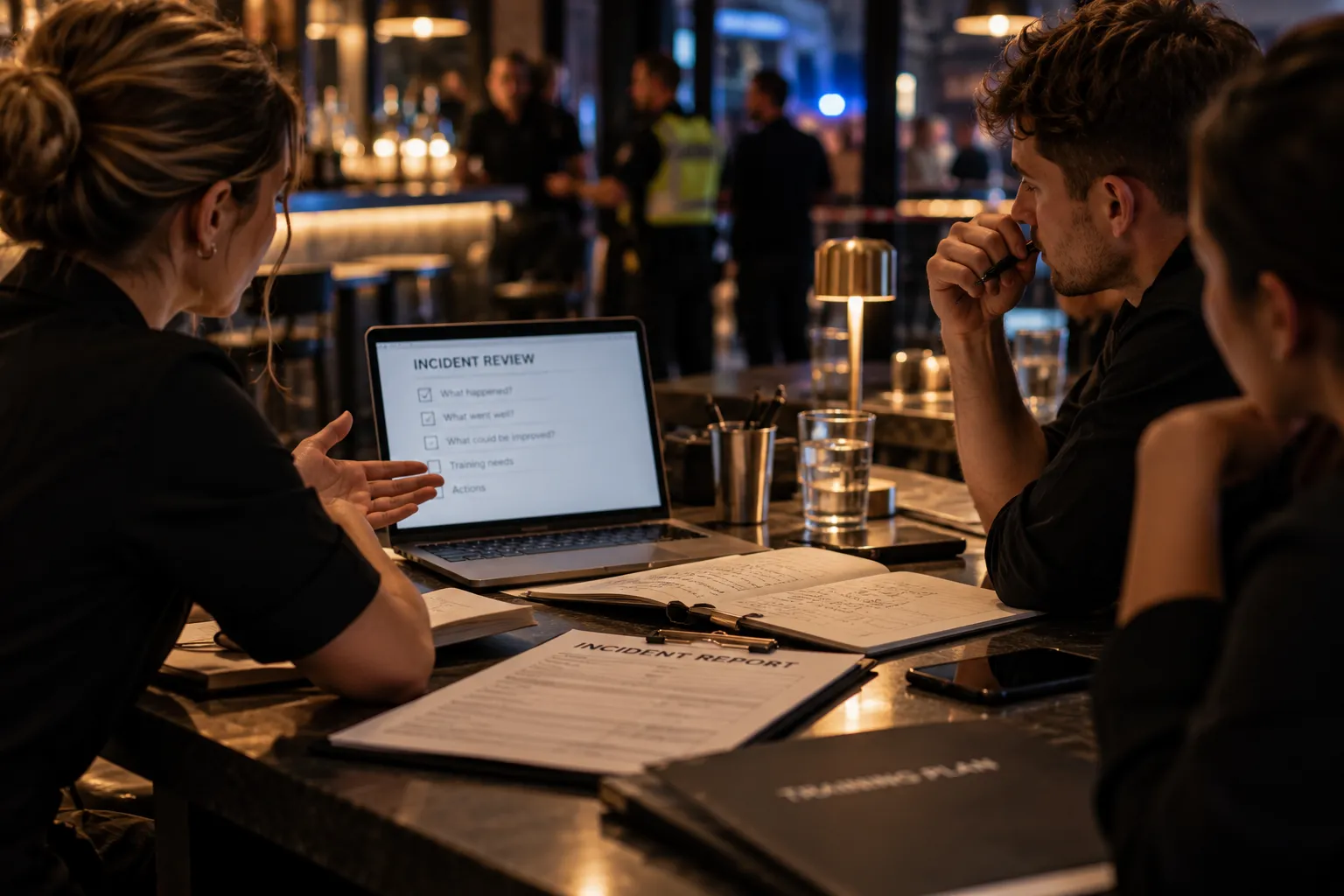
A confrontation, age-verification failure, a poorly handled welfare concern or any other incident can expose gaps in staff knowledge, communication or the procedures your team follow. Reviewing these gaps in the aftermath of an incident and turning those findings into practical licensing training for your staff can help your team prepare for something similar in the future. This can start with a simple debrief afterwards.
The aim is to establish what happened, recognise what worked well and what didn’t and establish improvements that staff can put into place in practice.
In this blog,Ray Bailey, Director of Training and Educational Lead at Complete Licensing, explains how licensing incidents can help premises owners to educate staff and identify gaps in policies and procedures.
The aftermath of a licensing incident
When a licensing incident occurs, the immediate priority is the safety and welfare of customers and staff. Existing emergency procedures should be followed, the emergency services called where needed and ensure employees act appropriately.
If a crime occurs, it’s important to preserve the scene as safely as possible and follow police instructions. Avoid cleaning or moving any potential evidence unless necessary to protect life or prevent further harm. How many crime scenes are there? There may be more than you think. Is it better/easier to preserve one larger scene or many smaller ones?
Once the immediate risks have been addressed, a responsible manager should take control of the next steps. Depending on the circumstances, these may include:
● Identifying witnesses and retaining relevant staff accounts
● Preserving relevant CCTV before it is automatically overwritten, making it immediately available for viewing by first responders
● Completing factual incident records
● Informing the premises licence holder and designated premises supervisor
● Checking applicable reporting requirements and premises licence conditions
● Introducing any immediate changes needed to manage an identified risk
Always ensure that your internal review of what happened does not interfere with a police investigation or encourage staff to agree to a shared version of events.
Establish what happened before deciding on the required training
If something at your premises goes wrong, it’s easy to state that ‘staff need more training’ but, training is only useful if you’re able to identify what employees need to do differently in relation to how the incident was handled or if anything in the lead up could have been done differently to prevent it from happening.
Start by building a timeline using the information you have available. This might include incident logs, CCTV, refusals records, staffing rotas and individual account and a full debrief.
Look carefully at the sequence of events:
● What was the first indication of a problem?
● Who noticed it, and what did they do?
● When was a manager or supervisor informed?
● What instructions were given?
● Were those instructions understood and followed?
● What happened after the incident?
In addition to looking at what went wrong, identify what went well. You might find that an employee recognised an incident early, called for assistance promptly or supported a vulnerable customer in the right way. These actions can provide useful examples for future training.
Identify whether the problem involved knowledge, procedures or resources
If an incident occurs, it doesn’t always mean an employee failed to follow their training. A review might reveal that instructions on how to handle a specific situation were unclear, equipment was unavailable or responsibilities were not assigned properly.
For example, an employee might know they need to contact a manager in a particular situation but may not have been able to get hold of one during a busy shift. Simply repeating that instruction during staff training will not resolve the underlying problem.
Instead, following an incident, ask whether the staff involved:
● Understood the relevant procedure
● Could access the equipment or support they needed
● Knew who was responsible for making decisions
● Received consistent instructions from different managers
● Had a realistic opportunity to follow the procedure
If the problem was in relation to staffing, supervision or equipment, it should be addressed alongside training. Employees’ working arrangements should always allow them to apply their training during a busy shift.
It is always worth having a debrief post incident (after the dust has settled and after any accounts have been recorded) which should involve all those that played any part in proceedings. Encourage an open dialogue where everyone can express their views while the events are still fresh in their memory.
Ensure that incident log entries are made by any staff involved and any near miss or RIDDOR (Reporting of Injuries, Diseases and Dangerous Occurrences Regulations) requirements are met before a debrief to maintain the integrity of any evidence gained.
Also bear in mind that the victim(s) may be staff members too. Consider whether there are any immediate welfare needs that need to be addressed.
Turn your findings into specific staff training
The most useful training has a clear connection to the incident and the improvements identified. It should help employees reduce the risk of similar problems and respond more effectively if they occur.
Think about the tasks you want staff to be able to complete once the training is finished. These could include checking identification correctly on a busy weekend shift, calmly explaining why someone is being refused entry or refused alcohol service, or making an accurate incident log entry.
The examples below show how findings can become practical training actions.
Finding from the review | Training focus | How to check understanding |
Staff were unsure if a manager needed to be involved | Escalation responsibilities and contact arrangements | Ask staff to work through a realistic scenario |
A refusal was not communicated correctly | Refusals procedures and shift communication | Practice the way the refusal should be recorded and shared |
An incident report omitted key details | Factual reporting and the information required | Ask employees to complete a sample report |
A customer’s welfare concern was passed between teams | Ownership of welfare concerns and clear handovers | Run a scenario involving bar staff, supervisors and security |
Incident log entries are often made by staff who do not have English as their first language. They may speak English fluently but find it difficult to write an account in sufficient detail or with enough clarity. Staff may therefore feel reluctant to expose perceived failings by completing notes after an event.
There is no requirement for records to by written in English. An account can be obtained in the person’s native language and translated later, if necessary, although an English summary should be obtained at an early stage. Someone else can also write the account for them, provided they do not alter what the witness is trying to say and the process remains transparent throughout. However, this level of assistance is likely to only be necessary in the most serious situations.
Ensure that training reflects each employee’s roles and responsibilities. Bar staff, door supervisors and duty managers may require different training because they have different roles but should still understand how their responsibilities connect.
For more information on building a consistent approach to training, read ourguide on the benefits of regular licensing training.
Use realistic training scenarios to put policies and procedures into practice
A written policy explains the process employees are expected to follow. However, a practical exercise helps to establish whether employees are able to follow it under pressure or during a busy shift.
Use an example based on the incident that occurred and the lessons that can be learned from it.
For example:
A customer who has already been refused service approaches another member of staff at a different part of the bar. The venue is busy and that employee has not been informed of the earlier refusal. What should happen next, and how could the team prevent the communication gap?
Work through who should act, what they should say, when a supervisor should be involved and what should be recorded. You can then change the circumstances to test staff’s understanding. What should they do if the duty manager/PLH is busy? What if a temporary employee is covering the shift?
Testing whether employees can answer these questions helps you to understand whether the relevant procedure works in real conditions.
Update procedures alongside staff training
If, following an incident, your review highlights a procedure that needs to be altered, update it. This ensures that, the next time something similar occurs, staff are better equipped to deal with it.
Your revised procedure should explain:
● What employees need to do
● Who is responsible for each step
● When to involve a manager or the emergency services
● What information must be recorded
● What to do if the normal process cannot be followed
Check that these revised procedures and policies align with the conditions of your premises licence. Brief everyone that needs to be aware to ensure the procedure is altered across your premises.
Complete Licensing’spolicy design and review service can help turn the findings of a review into practical procedures for your business.
Keep meaningful training records
A record that someone attended a training session shows that someone was present but, it doesn’t necessarily show that they understood the training or are able to apply it in a real scenario.
After training, keep a record of:
● The date and subject of the training
● The employees who completed it
● The procedures and materials covered
● How understanding was assessed
● Any further support or training required
● Who is responsible for follow-up

Review whether changes are working
The response to an incident should continue far beyond the initial assessment and resulting training session.
Each procedure or improvement made should be recorded and monitored. You should then regularly check to see how the revised arrangements translated during normal trading, including busy periods and shift changes.
Practical checks help to establish whether staff are following the new procedures and whether there are further weaknesses that need to be fixed. Ourongoing licensing compliance support can help operators assess working practices and identify areas that need further attention. This is not about apportioning blame, but identifying vulnerabilities in the business model.
For more on making these checks part of everyday operations, read our guide onwhy ongoing licensed premises compliance checks matter.
Be prepared to explain the steps taken following the incident
If, following an incident, the police or licensing authority raise concerns, it’s useful to be able to explain what you have done since the incident occurred.
A clear action plan can help you show the problems identified, what you changed, who received training and how the improvement is being monitored on an ongoing basis.
Where an incident leads to apremises licence review, it’s important to seek advice immediately. Training and improvements may form part of the response, but they do not guarantee a particular outcome.
Acting on concerns early gives you an opportunity to address weaknesses in your premises before they become recurring problems. Our guide topreventing your business from sleepwalking into a premises licence review explores how regular checks, staff training and timely action can help.
How Complete Licensing can help
Complete Licensing helps operators to review incidents, identify gaps in working practices and develop training that reflects the needs of their premises.
Our services include incident reviews, premises-specific training, policy development and ongoing compliance support. Following an incident, it’s important to help your team understand the changes required and how they can be applied during day-to-day trading.